How I helped Freshworks transform sentiment analysis from an AI capability into a trusted workflow across two enterprise support platforms.

Company
Freshworks
Products
Freshchat
Freshdesk
Team
Product Manager
ML Engineers
Frontend Engineers
Support Operations
Challenge
Freshworks had invested heavily in sentiment analysis capabilities through Freddy AI, investing in machine learning that could help support teams identify frustrated customers, prioritize conversations, and improve response quality at scale. but adoption remained near zero because support agents didn't trust AI-generated recommendations.
What I led
I led end-to-end product design across discovery, strategy, trust framework design, cross-product rollout, and analytics expansion that transformed sentiment analysis from a machine learning capability into an operational workflow
Reframed the initiative from prioritization efficiency to AI adoption
Defined trust patterns for AI-assisted decision making
Buily agent, administrator, automation, and analytics experiences
Established reusable interaction models later adopted across Freshchat and Freshdesk
Partnered with PMs, ML engineers, and platform teams to operationalize sentiment intelligence
Project complexity
3 PM transitions (re-established alignment and success metrics)
Evolving ML model (designed the experience resilient to changing prediction quality)
Multiple stakeholder groups (Balanced needs of agents, administrators, support leaders, and ML teams)
Cross-product alignment (Adapted trust patterns across synchronous and asynchronous workflows)
Impact
90% adoption increase
750+ accounts enabled
40% reduction in manual prioritization effort
Expanded into multiple support platforms
01 · The Business Context
AI capability existed. Adoption didn't.
Freshworks serves organizations ranging from small businesses to Fortune 500 companies. As customer conversations increased across chat and ticketing channels, support teams faced a growing challenge: how do agents quickly identify which conversations need attention first?
The company had already invested in sentiment analysis models capable of detecting frustration, urgency, and satisfaction from customer conversations. The expectation was straightforward: Use AI to help agents prioritize work more effectively.
However, there was zero adoption.. Agents continued relying on manual prioritization rather than AI recommendations.

This wasn't a machine learning problem. It was a trust problem.
Business risk: Why did this matter?
Significant investment in Freddy AI was generating limited adoption
Agents continued relying on manual triage despite available predictions
Customer frustration signals remained difficult to identify at scale
AI capability existed, but behavioral adoption did not
02 · Reframing The Problem
Building alignment before building UI
"I'd rather scan conversations myself than act on something I don't trust."
Support agent · Research interview
As project ownership shifted across multiple PMs, assumptions around success metrics, AI transparency, and workflow integration continued evolving.
To maintain momentum, I facilitated alignment sessions across PMs, ML engineers, support teams, and leadership stakeholders.
Outcome:
Adoption, and not prioritization speed, was the primary business risk.
Original goal
Help agents prioritize faster
Reframed goal
Help agents trust AI enough to incorporate it into their workflow
Research participants: Support agents · Support admins · Internal Freshworks support team
03 · What was breaking trust?
Four barriers, consistently surfaced
The challenge wasn't prediction accuracy. The challenge was confidence calibration between humans and AI.
Interpretation
Agents couldn't understand why two conversations with similar content received different sentiment classifications.
Verification
Agents manually opened conversations to validate predictions.
Control
Agents feared losing decision-making authority.
Flexibility
Different organizations interpreted sentiment differently.
04 · Designing for trust under uncertainty
Cross functional negotiation
Engineering and product constraints:
Product requirements, confidence thresholds, and model behavior were changing throughout development, requiring the experience to remain useful even when prediction quality fluctuated.
Wrong question
How do we expose sentiment predictions?
Right question
How do we help support agents confidently use the evolving intelligence?
Different stakeholders prioritized different outcomes:
ML team → Prediction accuracy
Product → Feature adoption
Support teams → Workflow efficiency
Leadership → AI strategy ROI
I worked with ML engineers to simplify confidence communication, partnered with PMs to redefine success metrics around adoption, and collaborated with support teams to ensure AI recommendations fit existing workflows rather than replacing them.
Principles for trust in AI, through design
After presenting research findings and prototype evaluations, leadership aligned on a broader opportunity: solving AI adoption rather than sentiment visibility. This shift expanded the project scope from a feature launch into a platform capability.
Instant comprehension
AI should be understood within seconds.
Human control
AI should assist judgment, not replace it.
Transparent feedback
Users should be able to challenge predictions.
Organizational flexibility
Teams should adapt the system to their own workflows.
05 · Evaluating trust mechanisms
How do we operationalize AI trust across an enterprise platform?
The tradeoff decision
Because trust was the primary design challenge, I explored multiple approaches for communicating sentiment confidence, emotional context, and AI recommendations.
Through iterative testing with support teams, I evaluated:
Numerical scores
Hypothesis: Precise sentiment representation.
Finding: Required interpretation and slowed decision-making.

Colored cards
Hypothesis: Fast visual scanning.
Finding: Conveyed urgency but created visual clutter and overwhelming anxiety

Directional arrow
Hypothesis: Communicate sentiment movement and conversation trajectory at a glance.
Finding: Effectively conveyed change over time, but failed to communicate the customer's current emotional state, making prioritization difficult.

Sentiment tag
Hypothesis: Provide an explicit label for customer emotion that is easy to understand and categorize.
Finding: Easy to interpret, but felt static and required additional reading, slowing down rapid conversation scanning.

Outcome: Agents interpreted emotional states significantly faster than numerical abstractions. This led to the emoji-based system.
Why? Agents already think emotionally. When reading a conversation, they don't think "Sentiment score: 0.84." They think "This customer sounds frustrated."

Emoji indicators best balanced comprehension, speed, and confidence and aligned with existing mental models, requiring zero translation effort, and reduced cognitive load.
06 · Designing the agent experience
Designing the trust ecosystem
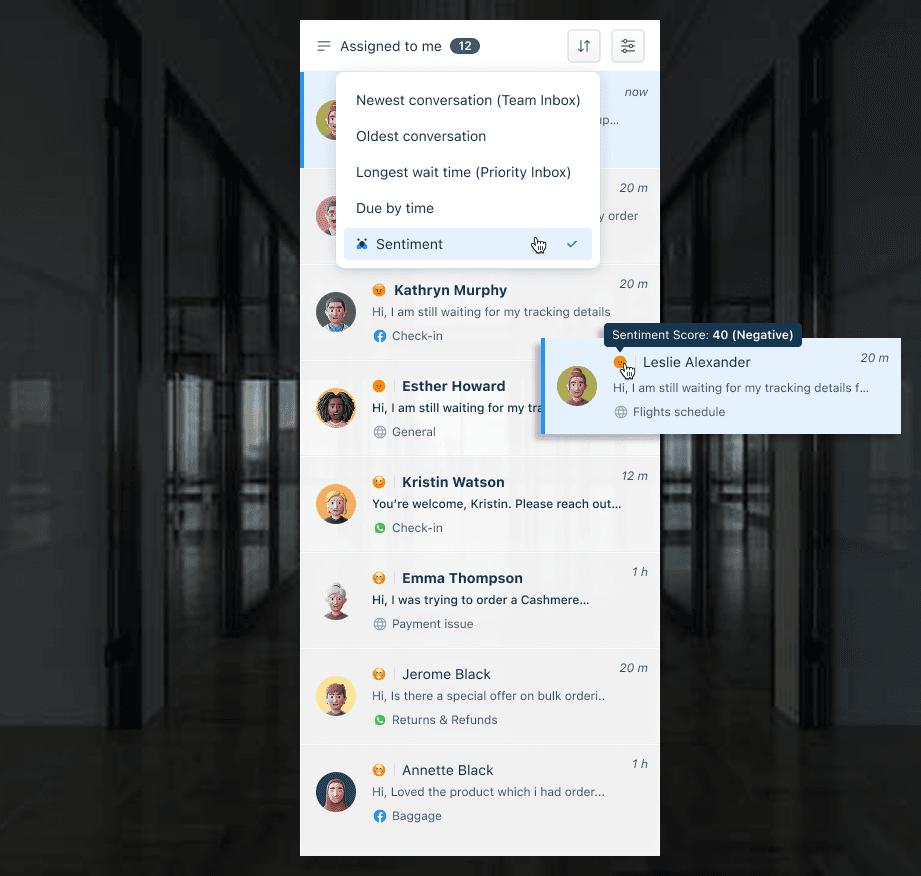
The first implementation focused on helping agents quickly identify customer sentiment while managing multiple conversations simultaneously.
Real-time sentiment visibility
Conversation sentiment displayed directly within inbox. Previously, agents had no way to understand context and sentiment. Now they can see and act faster.

Sentiment-based prioritization
Agents could sort conversations by sentiment (negative to positive) and focus on high risk conversations.

Explainability via hover states
Hover interactions provided additional context without overwhelming the interface, balancing simplicity with transparency.

Beginning vs ending sentiment
Transparent measure of emotional outcomes that helps answers "are we actually improving customer experiences?".
It is an important metric to gauge support experience over time. Additional layer of CSAT. Previously very hell bent on closing ticket and relied on CSAT

07 · Designing for AI failure
Acknowledging uncertainty instead of hiding it
One of the most important design decisions involved handling incorrect predictions. Many AI systems attempt to hide failure. I took the opposite approach: when sentiment predictions were incorrect, agents could provide feedback directly within the workflow.
Preserved user trust
Agents retained authority over decisions
Created learning signals
Feedback became input for future refinement
Rather than positioning AI as infallible, the experience acknowledged uncertainty and encouraged collaboration between humans and machines.
08 · Scaling the framework across products
From feature to platform capability
The initial launch in Freshchat validated a new trust model for AI-assisted support workflows. Rather than treating sentiment as a standalone feature, I worked with teams in Freshdesk to establish reusable patterns for visibility, validation, feedback, and control that could scale across products.
Though both products served support teams, their workflows differed significantly. Freshchat focused on real-time conversational support. Freshdesk focused on ticket management and asynchronous workflows. The challenge was maintaining consistency while respecting each product's context.
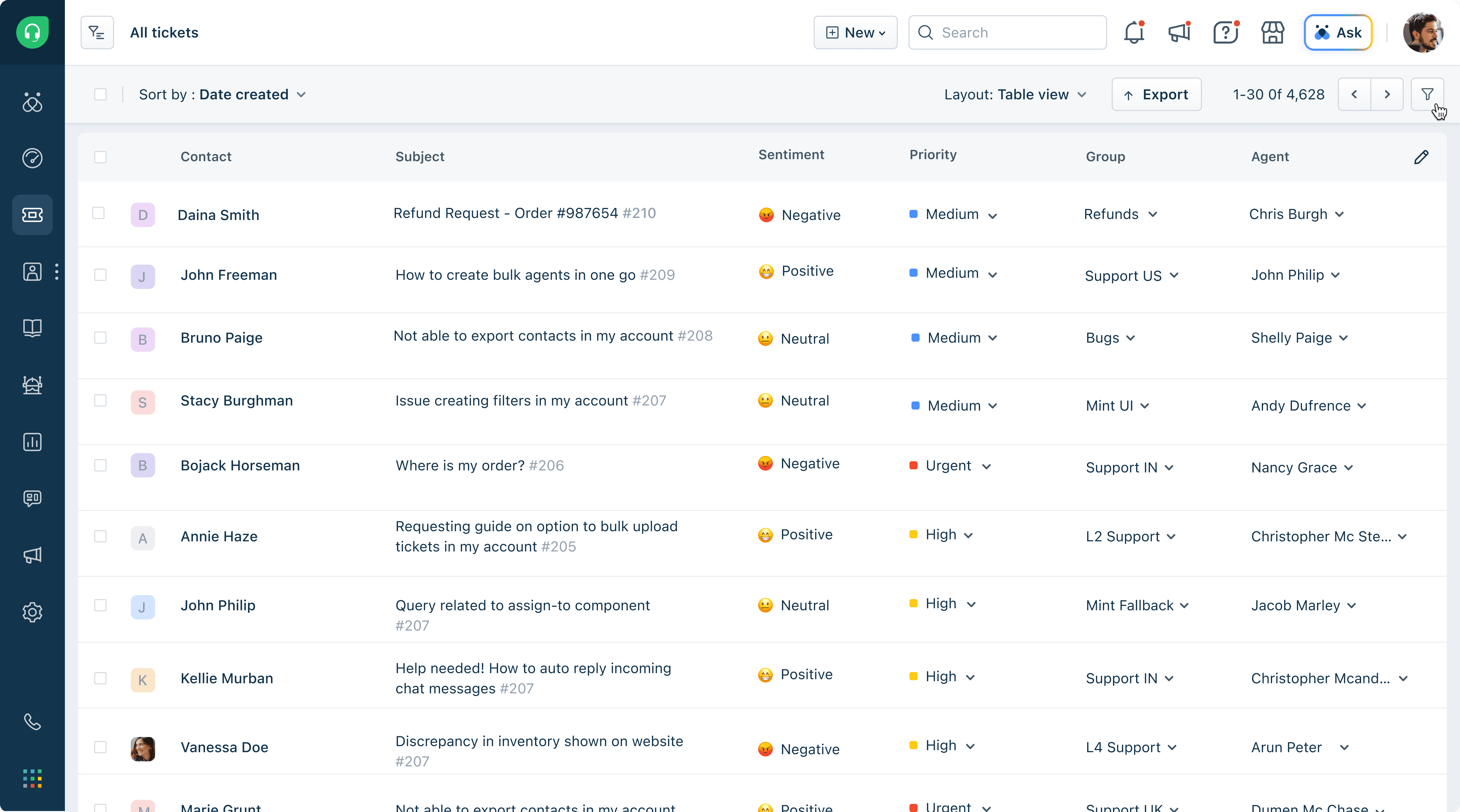
Shared patterns
Sentiment visibility
Feedback mechanisms
Prioritization logic
Product-specific adaptation
Information hierarchy
Influenced logic (real time vs async)
Workflow integration
Why Freshdesk mattered: Business opportunity
Freshdesk represented a significantly larger ticket management workflow. Expanding there increased reach and established a reusable AI interaction pattern across support products.
09 · Beyond agents: Supporting administrators
Trust wasn't only an agent problem
Why admin controls matter
Support leaders needed confidence that sentiment behavior aligned with organizational policies and customer expectations. A healthcare provider and a software company often interpret customer frustration differently.
This required balancing centralized control with frontline flexibility and simplicity.
10 · Turning sentiment into operational intelligence
From "how does this conversation feel?" to organizational insight
While agents needed real-time sentiment signals to prioritize conversations, support leaders faced a different challenge. They weren't trying to understand a single customer interaction. They were trying to understand patterns across thousands of conversations.
How might we use sentiment as a trigger, not just as a signal?
Rather than requiring agents to manually monitor every conversation, automation workflows could take action when specific sentiment thresholds were reached, such as escalation routing, VIP intervention, topic based assignment.

Automation
Agent questions
How is this conversation feeling?
Which customer needs attention?
What should I do next?
Leadership questions
What patterns are emerging?
Which issues create frustration?
What should the business improve?
Designed operational intelligence layers that translated thousands of sentiment signals into actionable insights for support leaders.
To help support leaders understand customer experience at scale, I designed a dedicated analytics and dashboard experience that surfaced sentiment trends across conversations, teams, and automation workflows.
This allowed teams to identify recurring friction points, measure support effectiveness, and understand whether customer sentiment improved throughout the conversation lifecycle.
Admins could answer:
Are conversations ending happier than they start?
Is automation improving customer sentiment?
Are bots helping or hurting customer sentiment?

Dashboard

Analytics
This transformed customer sentiment from an isolated AI prediction into an operational decision making system used by agents, managers, and admins and business leaders.
11 · Creating a learning ecosystem
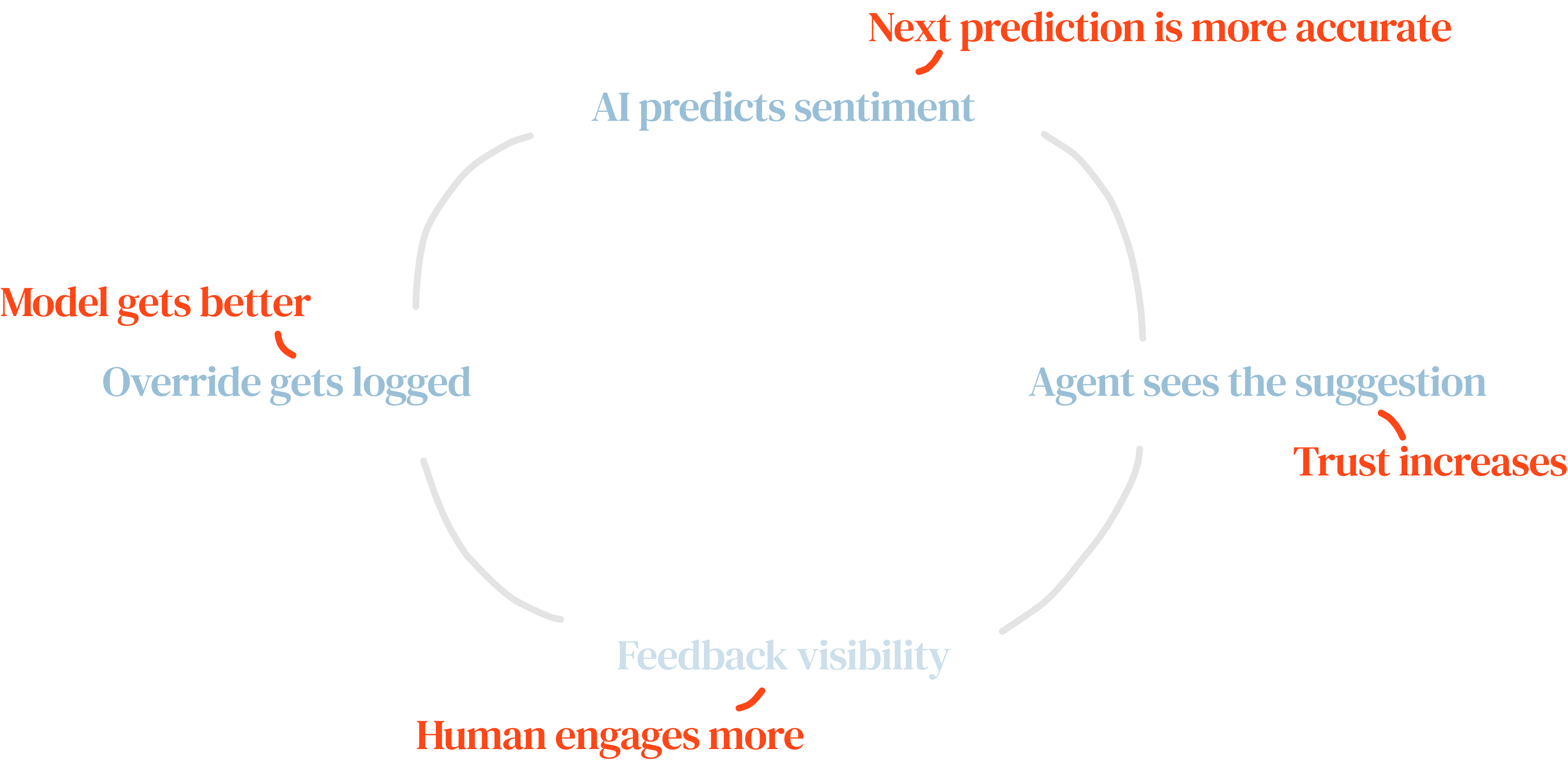
The full loop
What began as a sentiment feature evolved into a broader ecosystem connecting users, AI systems, operational insights, and business outcomes.
12 · Impact
From manual prioritization to trusted AI workflow
Business impact
90% increase in adoption after GA
Improved return on Freddy AI investment.
750+ accounts
Started using the feature since GA
Operational impact
40% reduction in manual prioritization effort
5x efficiency
Faster identification of high risk conversations
30% model improvement
AI confidence score over time through feedback loop overrides
Platform impact
Established reusable AI trust patterns
2 cross product rollout + active expansion across ITSM
12 · Key decisions & tradeoffs
What I chose not to do, and why
Why not automate prioritization completely?
Agents needed visibility and trust before automation could be introduced responsibly.
Why not expose model confidence scores?
Confidence scores increased cognitive effort without increasing decision quality.
Why allow users to challenge AI predictions?
Trust grows when users remain in control. Feedback also created valuable training signals.
Why design analytics alongside agent workflows?
Adoption requires value at multiple organizational levels, not only for frontline users.
14 · What I learned
Designing the relationship, not the indicator
Adoption is the real metric
The success of an AI capability depends less on prediction quality and more on whether people trust it enough to change behavior.
AI adoption is a design challenge first
Even highly accurate systems fail when users don't trust them.
Human control increases adoption
Allowing users to validate and challenge predictions strengthened trust rather than weakening automation.
15 · Reflection
This project taught me that AI adoption isn't created at the moment of prediction. It's created through the surrounding ecosystem. How intelligence is communicated, challenged, measured, and operationalized across an organization. The most impactful design decision wasn't the sentiment indicator itself. It was creating feedback loops that connected agents, models, and business stakeholders into a shared learning system.